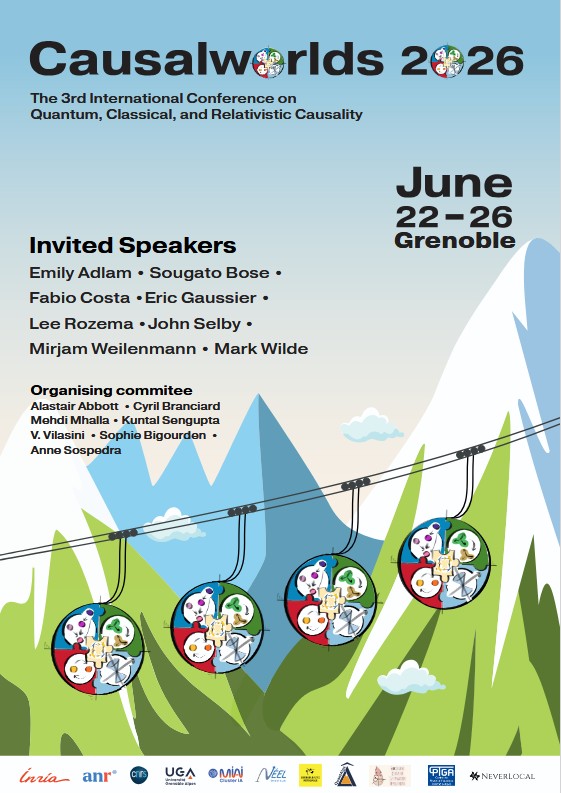
Understanding causality is foundational to science and has wide-ranging applications, yet there are several distinct notions of causation. Recently, there have been important developments on the role of causality in quantum physics, relativistic physics and their interplay. These have unearthed a plethora of deep and fascinating questions regarding the nature of causation in physical theories, emergence of space-time structure and how relativistic principles can shape the landscape of quantum information processing. At the same time, causal reasoning is central in classical statistics, and has become a crucial tool in machine learning, with applications ranging from big data to healthcare. The interface between classical and quantum causality has also been crucial for identifying when and how quantum theory can surpass classical models in information processing. Causalworlds aims to bring together researchers from different areas of physics, computer science, mathematics and philosophy working on such questions related to causality, both from fundamental and applied perspectives, to provide a venue for cross-pollination of ideas and techniques across these disciplines and consolidate efforts towards a more unified understanding of causation.
The scope of the conference includes (but is not limited to):
- Quantum and classical causal inference and causal models
- The role of causal structure in information processing
- Indefinite causality and quantum reference frames
- Cyclic causality and time symmetry
- Causality in quantum field theory and quantum gravity
- Experiments in causality and applications
Invited speakers:
- Emily Adlam (Chapman University)
- Sougato Bose (University College London)
- Fabio Costa (Nordita, Stockholm University)
- Eric Gaussier (LIG, Université Grenoble Alpes)
- Lee Rozema (University of Vienna)
- John Selby (ICTQT, University of Gdańsk)
- Mirjam Weilenmann (Inria Saclay, Télécom Paris)
- Mark Wilde (Cornell University)
Scientific organisers:
- Alastair Abbott (Inria Grenoble)
- Cyril Branciard (Institut Néel, CNRS)
- Mehdi Mhalla (LIG, CNRS)
- Kuntal Sengupta (Inria Grenoble)
- V. Vilasini (Inria Grenoble)
 QuantAlps